
Six Years of Patience: 0.05 BTC on Legacy Hashrate
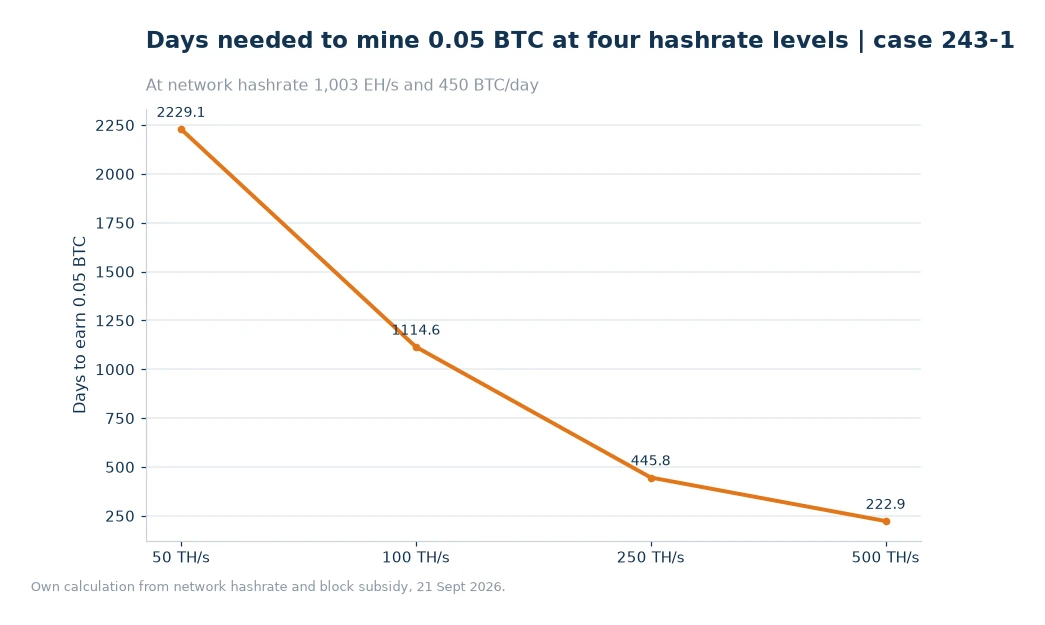
Some hardware is old enough that the target stops being a schedule and becomes a way of life. At 50 TH/s, 0.05 BTC takes 2,229.1 days, or 6.1 years, while 500 TH/s covers the same ground in 222.9 days. The gap is a factor of ten in hashrate and a factor of ten in patience.
Key takeaways
- 0.05 BTC takes 2,229.1 days at 50 TH/s, 1,114.6 at 100 TH/s, 445.8 at 250 TH/s and 222.9 at 500 TH/s.
- Six years is longer than the service life most miners are designed for, so spare parts become part of the plan.
- Pool Hashrate is indifferent to what you paid for the machine; a rising network total lengthens the wait for everyone.
- Pool Luck averages away over years, but the price of the coins at the end is the variable that decides whether the wait was worthwhile.
The arithmetic of a very long target
Legacy hardware invites a particular kind of optimism. The machine is already paid for, the electricity is already connected, and the only cost is the power it draws. That makes the marginal decision look easy: keep it running, because anything it earns is profit. The arithmetic does not quite support that, and the reason is time.
At 50 TH/s the daily credit is 0.00002243 BTC, so a year produces 0.008187 BTC. The 0.05 BTC target needs 2,229.1 days, which is 6.1 years. During those years the machine will need fans, a power supply, and probably a board. Each of those is a cost the marginal view assumed away.
What six years does to a machine
Fans are the first consumable. They run continuously in a warm box and lose efficiency long before they stop entirely. Power supplies are next, because capacitors age and a supply that delivered 3 kW at 25°C may not deliver it at 40°C in July. Solder joints and connectors also move with thermal cycling, which is why intermittent faults appear in old units and not in new ones.
A long plan should therefore include a spares budget and a maintenance interval, not just a coin target. If the machine needs one fan a year at a modest price, that is a known cost. If it needs a board in year three, the plan has to absorb it or the schedule slips by however long the part takes to arrive.
Pool Hashrate does not care about sentiment
The ViaBTC Pool Hashrate number is a reminder that the network has no memory of your purchase price. It measures the competition, and the competition grows. A machine that was competitive when it was bought can become marginal without anything changing in the room.
For a six-year target this is the dominant risk. A 5% annual rise in the network total compounds to more than a third over six years, which stretches 2,229 days to roughly 3,000. The exact path is unknowable, but the direction has been consistent enough that a long plan should assume some growth rather than none.
Pool Luck over years averages out
The short version of luck is a pool finding more or fewer blocks than expected in a given week. Over six years, those deviations accumulate into something close to the expected total, provided the pool itself stays healthy and the miner stays connected. The variance that matters at this horizon is not luck; it is downtime, difficulty and price.
That is a useful simplification. It means a legacy miner does not need to chase a lucky pool or time a switch around a block. It needs a stable connection, a maintenance routine and an honest record of what it actually produced. The rest is arithmetic that will not be improved by watching a dashboard.
The same target at four machine sizes
The table expresses the same target in days, years and yearly output, which is the unit that matters when the horizon is measured in seasons rather than weeks.
| Hashrate | Days to 0.05 BTC | Years | BTC per year |
|---|---|---|---|
| 50 TH/s | 2229.1 | 6.11 | 0.008187 |
| 100 TH/s | 1114.6 | 3.05 | 0.016374 |
| 250 TH/s | 445.8 | 1.22 | 0.040936 |
| 500 TH/s | 222.9 | 0.61 | 0.081871 |
The yearly figure is the one to set against the power bill. At 50 TH/s, 0.008187 BTC is about $693 a year at $84,692, or $58 a month. A rig pulling a kilowatt against a six-cent tariff lands near $44 for the month, before any cooling load is counted, so the surplus is small but not zero. At a higher tariff it disappears.
The same comparison at 500 TH/s is a different business. Annual output is 0.081871 BTC, about $6,933, and the power draw is roughly ten times as large. The surplus is bigger in absolute terms, but it is also more exposed to a tariff change, because the electricity bill is now the largest line in the plan rather than a rounding item.
Selling the machine versus waiting
The alternative to six years of running is a sale today. The comparison is not the sale price against the coin target; it is the sale price against the net output the machine will produce before it fails. A unit worth $300 today and producing $14 a month of surplus has a two-year payback, after which every month is a small gain, assuming it lasts.
That comparison changes with the tariff, the resale market and the owner's tolerance for maintenance. It is also reversible in a way that the coin target is not: a machine sold can be replaced, while six years of a particular schedule cannot be recovered. Write both numbers down before deciding, because the answer is rarely obvious from either one alone.
There is a middle path worth naming. Keep the machine until its next significant failure, then decide with the repair quote in hand. That rule avoids both premature selling and open-ended waiting, and it turns an emotional question into a threshold that can be applied on the day the fan starts screaming.
Worked example
Build the six-year case and the annual figure, then check the 500 TH/s alternative.
- The daily rate per TH/s comes from 450 ÷ 1,003,000,000, which is 0.00000044865 BTC.
- For 50 TH/s the product is 50 × 0.00000044865 = 0.00002243 BTC a day.
- Days to 0.05 BTC: 0.05 ÷ 0.00002243 = 2229.1.
- Years: 2229.1 ÷ 365 = 6.11.
- Annual output: 0.00002243 × 365 = 0.008187 BTC, about $693 at $84,692.
- At 500 TH/s: 0.00022433 BTC a day, so 0.05 ÷ 0.00022433 = 222.9 days, or 0.61 years.
Frequently asked questions
How long does 0.05 BTC take at 50 TH/s?
2,229.1 days, or 6.11 years, with a daily credit of 0.00002243 BTC while the network sits at 1,003 EH/s.
Is it worth running a 50 TH/s miner for six years?
Only if the surplus after power and maintenance is positive and you accept the horizon. At $0.06 per kWh a 1 kW rig costs about $44 a month, against roughly $58 a month of gross output at current conditions.
What changes the six-year estimate most?
The network total. A 5% annual rise compounds to more than a third over six years, which would push 2,229 days towards 3,000; Pool Luck averages out over that span by comparison.
Put a price on the wait before you commit to it
Multiply the yearly output by the years you are willing to run, subtract the power and the spares, and compare the result with what the machine would fetch today. If the difference is small, the choice is mostly about how much maintenance you want. If it is large, the arithmetic has made the decision for you.
The pricing page lists the settlement rates behind the credit, and the Statistics view shows the network total that governs the wait. Check the second one each quarter; it is the number that can quietly rewrite a six-year plan.
Sources: ViaBTC pool state, statistics and pricing pages; chain inputs read 21 Sept 2026: network hashrate 1,003 EH/s, difficulty 132.76 T, subsidy 3.125 BTC per block, 144 blocks a day, BTC $84,692. Annual figures use 365 days. Figures read 21 Sept 2026, published 24 Oct 2026[1].